

As bad as the incentives are that corrupt the US House of Representatives, those that operate on the US Senate are even worse.
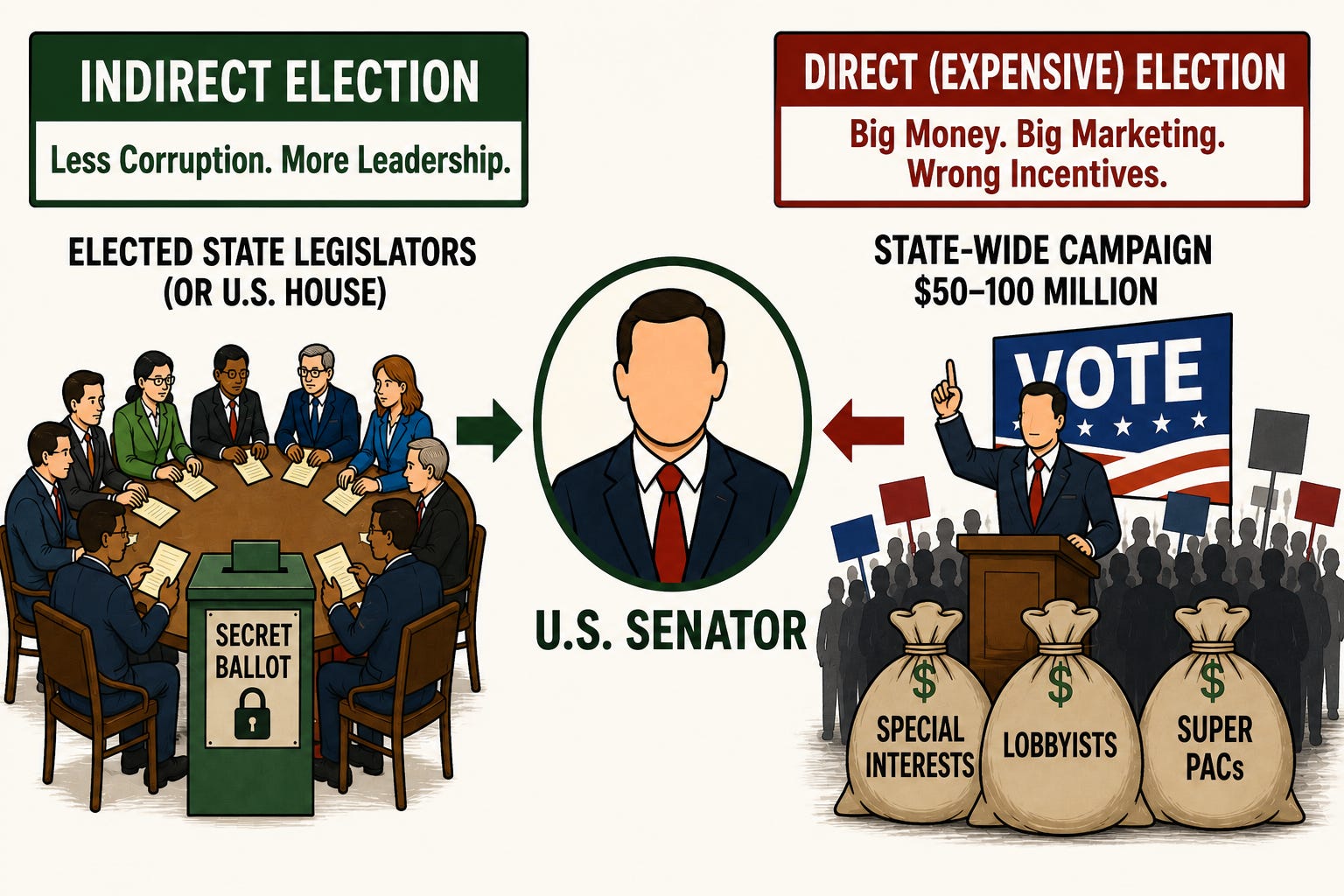
Senators are of course elected from districts that encompass entire states. In competitive US Senate elections, it’s now normal for a candidate to raise and spend $50-100 million.
Who could buy such an office, and why?
All the incentives in our American political system are perverse and contrary to the public interest, but the scale of the dysfunction is particularly grotesque in the US Senate.
Because of the extreme costs of Senate campaigns, those who choose to run are political animals, perhaps with unhealthy personality characteristics. They must constantly cut self-serving deals to advance politically. A candidate to the US Senate might be among the super-wealthy, with the capacity to lose millions of dollars on a bid for fame and power.
Once in office, the political careerist has the power to raise money from special interests through de facto bribery and extortion. Members of Congress will spend their time in office protecting those interests or furthering political careers. Concern for the long-term well-being of the nation or its people is seldom demonstrated in meaningful action.
Needless to say, it wasn’t supposed to be like this.
The US Senate, as envisioned by the Founders, was designed to cool any popular passions that might inflame the US House. The authors of the Constitution were worried about the weaknesses of democracy, but they probably worried too much. The anti-federalists were more prescient when they expressed concerns about the rise of a distant and corrupt ruling class. To be fair to the federalists, and James Madison in particular, they too were prescient with their concerns about the potential for special interests to capture the government. Supporters and opponents of the Constitution feared different sorts of corruption, much of which has come to pass.
The Senate, with fewer members and longer terms in office, was a place where the nation was supposed to stop and think before acting. With the Connecticut Compromise, the founders settled on an innovative solution for choosing US Senators, which was for them to be elected by state legislatures, and in this way, reinforce federalism. Or at least that was the intent.
By the late 19th Century, state legislators were routinely bribed by special interests, or party bosses, who chose the US Senators. Contrary to the Founders plan that the US Senate represent state interests, instead the Senate represented the interests of robber barons, powerful trusts and/or corrupt political machines.
To address the obvious problem, a mass movement of citizens added the 17th Amendment to the Constitution in 1913, which mandated the direct popular election of US Senators. It made bribery less direct and ham-fisted, but it also faded the distinctions in character between the US House and US Senate.
Originally, upper and lower houses were supposed to provide government with contrasting characteristics. In terms of classical political theory, lower houses were intended to represent the will of the people, generally middle-class farmers and burghers, who tended to embody the civic virtue more likely to be found among more ordinary folks. Commonsense, however, was prone to be swept away by popular passions. Upper houses, composed of the wealthy and better educated, could check the excesses of the people, and the people, through their representatives in the lower house, could check the principal flaws of the upper class, which was greed, lust for power, and corruption. Together, these houses were to check and balance each other. Two legislative houses, or bicameralism, was typically justified because each house would have some qualities that the other lacked.
That same general principle of imbuing each house with complementary characteristics could be reapplied today in new ways.
The bugbear of “unwieldiness” in a lower house consisting of tens of thousands of representatives, decentralized and legislating from home, isn’t going away quietly (for details on how a crowdsourced US House would operate, see Citizens Rising #4 and Citizens Rising #6).
Might it often be difficult to orchestrate so many competing visions and priorities?
Or maybe it turns out that too many part-timers don’t have the bandwidth to create effective and just solutions to the complex problems of 21st Century government.
These are improbabilities but there’s nothing wrong with building redundant defenses into the system for both practical and political reasons.
In the unlikely case that the above concerns prove valid, legislation could be created in a relatively small full-time Senate and approved by our very large geographically distributed House of Representatives, which would effectively check all the selfish interests currently feeding off the system. Even if the massively enlarged and decentralized US House produced no legislation at all—but merely voted on what came out of a much smaller Senate—the new system would still be a paradigm-altering improvement over what we have now.
The US Senate, however, cannot continue to be chosen as it is presently, from gigantic state-wide electoral districts. That would defeat the entire purpose of the essential reform, which is to remove the poison of selfish interests from dominating the political system. We need to replace money and marketing in politics with reputations and relationships. At least two options for the selection of US Senators, both consistent with American political traditions, come to mind.
First, the 17th Amendment could be repealed and US Senators once again chosen by state legislatures. It would be a system of indirect election that permits small, elected bodies—still democratically chosen—to govern without resorting to the large electoral districts that have grown into a fundamental cause of our democratic dysfunction. The key to the successful operation of this approach is that state legislatures must also be very large and populated by non-professional politicians, so that there are too many elected state office holders to successfully bribe or otherwise manipulate.
A second approach would be to revive an aspect of the Virginia Plan, of which James Madison was the principal author. The Virgina Plan called for the indirect election of US Senators by members of the US House. This approach makes sense if it turns out that the very large size of the lower house is problematic. In that case, the Senate would become a kind of executive committee for the House of Representatives, helping it organize and prioritize.
If getting things accomplished is the priority, then maybe Senate appointments through election by the House is the best approach. If promoting federalism is the priority, then choosing Senators by state legislatures might be better. Neither goal, however, is necessarily sacrificed by choosing the other option.
There’s another very simple and commonsense tool to prevent corruption in the selection of US Senators, whether chosen by state legislators or by the US House. Mandate that all votes for Senators be by secret ballot, which reduces the odds of effective bribery significantly. What interest would invest in a politician if that interest could never know for sure whether or not the politician carries out his or her side of the bargain?
Whether the US Senate is chosen by state legislatures or in the US House, we would be applying the classic democratic justification for bicameralism by providing one legislative house with the characteristic the other lacks. The US House would be very large, elected directly by the people, part-time, and geographically distributed (or remote) and perhaps not term limited (the mission of term limits, citizen government, would already be achieved). The US Senate, in comparison, would be relatively small, elected indirectly, full-time and in-person, based in Washington DC, and term-limited (term limits are always essential for the most powerful offices).
To further collaboration in the US Senate, the existing US House office buildings could be converted to Senate family housing, so that Senators would both live and work together during their limited tenures in office, to foster the sort of intimacy in the Senate that would be absent in the House. Again, the idea is to create upper and lower houses with useful yet contrasting qualities. In so doing, we would have updated our political system for the Information Age yet retained the established principles of the American founding.
Thank you for another informative and thought-provoking article. The impact of the 17th Amendment is largely ignored. It was a classic example of solving a legitimate problem the wrong way. It didn't eliminate the corruption; it simply shifted it. The parties quickly learned to adapt. As a result, the Senate essentially became the House... with a longer term.
While the cost of campaigns has always been absurdly high, it began to spiral out of control in 2008. Citizens United was decided in 2010, and by 2012, we began to witness billion-dollar-plus presidential campaigns. Senate campaigns soared to an average of $10.5 million, and up to $65 million if tightly contested. House seats cost #1.7 million on average, and more than $10 million if tightly contested. Elections have become a thing of the past. We now run auctions, and the dysfunction of our government reflects it.
Thank you again for shining a light on the 17th Amendment. One can only hope that someday, we will address the problem.