

Those who follow politics have observed what passes for a “debate” in the United States House of Representatives.
The camera will be on a Member of the House, passionately arguing for or against something. Often, he or she will hold up a placard that will visually emphasize the points the politician wishes to make.
To an everyday citizen watching from home, it might appear that there’s some serious deliberation going on, but then the camera pans out, and it’s revealed that the 435-seat House chamber is almost entirely empty. The politician is not debating with anyone. Rather, he is bloviating and pontificating to the camera.
Sometimes a lone politician from the other party will pepper the speaker with a few questions, but no one on the floor of the US House of Representatives is making public policy. It’s all for show.
At 435 members, the US House is too big to deliberate on anything. The US House is a stage for political pageantry and a place where votes are revealed, and nothing more.
Since the US House is already too big to deliberate as a body, how could it ever be made many times larger? Are we not now and forever doomed to suffer professional politicians elected from enormous political districts?
No. The lesson is quite the opposite. The fact is that nothing would be lost by increasing the House to 11,000, 22,000 or even 33,000 members, because large groups of legislators never design legislation: small committees do.
In other words, whether a legislature has 435 members or 11,000 members, a large group votes on legislation drafted by a small one.
The small group (the committee) must persuade the large group (the rest of the legislature) to support the legislation that it has produced, which is true no matter how large the large group is.
However, the bigger the large group that must be convinced, the more difficult it will be to bribe, arm-twist or otherwise manipulate. Counterintuitively, then, the larger body of elected representatives is more likely to approve better laws and more responsible budgets.
US House Committees currently average 40 members, which is where the work of government is actually done. Ideally, members of the full House study the bills, drafted in the committees, and discuss the legislation among themselves. By the time all 435 members arrive on the House floor to vote, each—almost without exception—has already decided how he or she is going to vote.
Of course, among professional politicians, the reality is that almost all vote blindly along party lines.
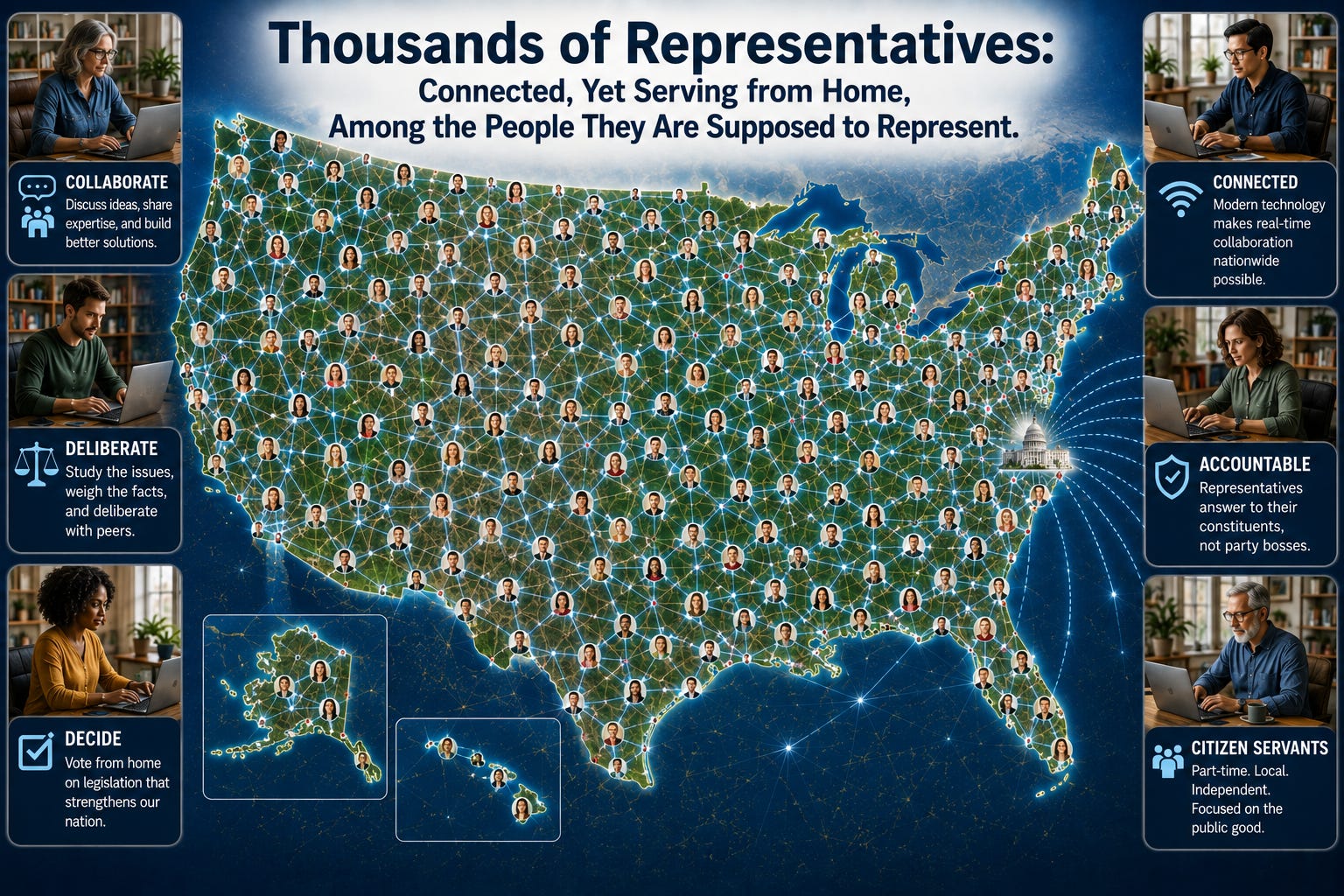
In terms of process, the size of the US House can scale upward by the thousands, without the mechanics of the system changing much at all. The only difference is that the many thousands of part-citizen representatives would vote from home and the committee work would be online.
Vote outcomes might be less predictable, but as discussed, slowing down a process is usually a strength, especially if the intent of that process is to actually address a public policy challenge rather than service some special or political interest.
Committees will be the key to the success of radically expanded and decentralized citizen-based democratic representation.
The US House currently has twenty permanent committees, including:
Agriculture
Appropriations
Armed Services
Budget
Education and Workforce
Energy and Commerce
Ethics
Financial Services
Foreign Affairs
Homeland Security
House Administration
Judiciary
Natural Resources
Oversight and Accountability
Rules
Science, Space & Technology
Small Business
Transportation & Infrastructure
Veterans’ Affairs
Ways and Means
In addition, most of these committees have subcommittees, of which there are 104. For example, under the Agriculture Committee there are the following subcommittees:
General Farm Commodities, Risk Management, and Credit
Forestry and Horticulture
Conservation, Research, and Biotechnology
Nutrition and Foreign Agriculture
Livestock, Dairy, and Poultry
Commodity Markets, Digital Assets, and Rural Development
Assuming a typical committee size of 40 members, multiplied by 124 committees and subcommittees, the US House has 4,960 roles to fill on committees and subcommittees, not counting special select committees and joint House and Senate committees. With 435 members of Congress, each member sits on six to eight different committees.
Even under ideal conditions, members would be spread too thin among several committees. Yet a seat on an important and complicated committee, like the Budget Committee, is or should be a full-time job. One could spend a lifetime trying to understand the federal budget.
Furthermore, look closely at the above Agriculture subcommittees. Do these make sense? Shouldn’t something as cutting edge and potentially powerful, for good or ill, like “Biotechnology,” be its own committee? Would the public not benefit if it had a group of representatives who devoted most of their time to this one important subject, and understood it well? Why is “Nutrition and Foreign Agriculture” not two separate subcommittees?
Members of Congress, rather than being too many, are too few, because they are spread too thinly over the many committees that are supposed to perform the nation’s important policy work and government oversight.
In fact, there are not enough specialized committees and too few members of Congress to cover the public policy landscape of an enormous and complex nation like the United States in the 21st century.
The closer we look, the more dysfunctional the process appears. The reality of serving in Congress today is the opposite of the ideal. Members spend a majority of their time fundraising and politicking, not doing policy work. Even much of the committee work is designed to score political points rather than solve problems. Most televised committee hearings are little more than partisan show trials. The very small number of bills that emerge from committees are today almost always partisan, without any support from the other party. Only about half of all bills that are reported out of committees are approved by party leadership for a vote on the floor. Innumerable good ideas never have a chance for passage.
Even if our elected leaders were primarily interested in solving problems, rather than scoring political points, there would be too few of them to oversee the mass and complexity of government today.
If Congress were radically expanded and composed of normal people, every government function and program could have citizen oversight to make sure public money was spent properly. Within a Congress consisting of many thousands of citizens could be found experts of every professional specialty needed to oversee every government function.
Citizen pilots and others associated with aviation would supervise the Federal Aviation Administration (FAA). Geologists, Environmental Scientists and ranchers could constitute a Bureau of Land Management (BLM) Committee. Astronomers and Engineers could oversee the National Aeronautics and Space Administration (NASA). Every major nation in the world could have a corresponding congressional committee of citizens to liaison with the US State Department and help guide foreign policy. The Pentagon would be overseen by many former servicemen and women.
And of course, every committee would surely also contain ordinary citizens, whose perspectives feel so neglected today. An Ethics Committee of everyday people would likely take its mission seriously by creating laws that truly protect against conflicts of interests.
Focused select committees with targeted expertise would be formed during crises. Within the Covid19 crisis alone, there must have been dozens of discreet topics and subtopics that required intense study.
It is clearly wrong to assume that the bureaucracy has everything under control, since a political appointee atop any particular bureaucracy is fully capable of burying innumerable good ideas or quashing an important discussion.
Often, it’s the bureaucracy, itself, that is the greater problem. Unsavory connections between the bureaucracy and industry can cause professional regulators and administrators to be corrupted through conflicts of interests; it’s a situation that demands popular oversight.
A large Congress composed of very many everyday citizens could have hundreds of specialized committees, studying every public policy challenge under the sun. Not every committee would need to produce legislation, but we’d have a government with a vast, independent and real-world knowledge base equipped to address almost any contingency.
With public policy being made by committees of citizen-experts and everyday people, Americans would be far better equipped to overcome insane media-driven partisan narratives that now have red and blue America living in almost entirely different and conflicting political realities. Citizens of goodwill from each side desperately need to sit down together, face each other’s best arguments, discover what is true, and compromise together. Normal people, unlike politicians, are not relentlessly partisan when it comes to public policy solutions. But to solve any public policy challenge, it’s going to take deep research, open mindedness, and some congeniality that can only come from people who care more about solving problems than playing politics. Again, that means opening the system to accomplished, but otherwise normal people, who simply want to give back. Such an open system means very small electoral districts, with low barriers to winning elections.
For those who will never run for office, committees could also be free to add non-voting members whose expertise may be required. Even when the barriers to running for office are low, many citizen-experts with needed talents will undoubtedly remain on the sidelines. Expert and talented participation should be wanted from all quarters in our new, Information Age, crowd-sourced democracy.
Practically, no legislator would serve on more than one committee at a time, to encourage the accumulation of specialized knowledge and keep the workload minimal, since almost all legislators would be part-time positions.
When a committee votes to recommend legislation, it could be required to produce a majority report and a dissenting minority report. Imagine no more than one bill before the legislature or Congress each week. Members would be required to perform their committee work and read about each week’s single piece of legislation (if that), including both the affirmative and negative arguments. The workload would be easily manageable for citizens with day jobs. Many hands make light work.
Certain leadership positions could be full-time to help manage the legislation flow and perhaps work on complicated tasks like budgeting, but these positions should be term-limited to prevent the accumulation of power in any small group of elected officials.
Though the above example features the US House of Representatives, the model can also be applied to state legislatures and local governments. We don’t need—and shouldn’t want—professional politicians anywhere.
Relatively huge de-centralized legislate-from-home elected bodies of non-professional politicians, working in specialized committees, is the first and essential Information Age fix to what’s gone wrong with our American political system, and for failing democratic systems everywhere. It’s a vision of escape from the cauldron of political dysfunction in which we find ourselves.
(Next: The role of upper houses, like the US Senate, in a system of Information Age democratic representation)